Mongolian Adventure Tours (M.A.T) LLC, established in 1992, is a pioneer tour operator in Mongolia.

EXPERIENCE THE TRUE ADVENTURE 

Facebook Flickr E-mail

High Mountain area

Khasagt Khairkhan Mountain (3578m)

Surrounded to the west and south west by the basin of the Zavkhan river. Here are many beautiful canyons and valleys, wilderness, steppe and taiga forests. In 1965 it was designated as a strictly protected area of centre about 274 km.

Alag Khairkhan Mountain (3789 m):

In Gobi-Altai Mountain south of the Mongol Altai chain. Here are many rare animals such as; wild sheep, ibex, lynx and high mountains grassy. It was designated as a National Nature reserve in 1996 (364 square meter)

Burkhan Buudai Mountain (3765m):

Beger khonkhor’s south west of the Mongol Altai chain. In 1996 the area was declared as the Burkhan Buudai Mountain Nature Reserve about 521 hectares.

Eej Khairkhan Mountain (2275 m):

This beautiful mountain located in Tsogt soum about 260 km south of Altai and is the home of several rare Gobi plant species. In 1992 it was declared as a National Nature Reserve and is 225 km².

Sutai Mountain: (4090m)

Is a beautiful Mountain with eternal snow and glaciers. The Zuil River located in Tonkhil sum flows into the Lake of Tonkhil.

Great Gobi Reserve:
Is divided into “Gobi A”, or Southern Altai Gobi, and “Gobi B” or Dzuungariin (East-handed) Gobi. “Gobi A” is over 4.4 million hectares in the southern part of the Aimag. “Gobi B” is 881,000 hectares in the Southwest of Gov-Altai and in neighboring Khovd. Together, the undisturbed area is the fourth largest biosphere reserve in the world and protects wild ass, Gobi bears, the wild Bactrian camel and jerboa, among other endangered animals.

Khuisiin Gobi (1200 m -1300 m):

It is located between Lake Dorgon and Shargiin Gobi. It is 150 kilometers long and 50 km wide. The Khuisiin Gobi is the most famous of the 33 Mongolian Gobi’s.

Mongol Sand dune:

This is a vast area of sand dunes that follow the Zavkhan River and terminate in the Khyargas Depression which are around 330 km long and an area of 2,724 km². In Jargalant soum valley of the Zavkhan River there are the beautiful fresh water lakes of Ereen and Ajig.

Tsagaan Gobi (Whit Gobi):

From Khaliun sum to Tseel sum east of the Khar Azarga flows the White River. As you cross the White khotol (mountain pass) there are over 100 Hunnu’s (ancient ethnic group) rock paintings on the wall. In 1998 it became the White Gobi Nature Reserve.

Shargiin Gobi: (950 – 1200m)

West of Altai city the Shargiin Gobi is 120 km long and 90 km wide. At the centre of the Shargiin Gobi is Shargiin White Lake, which is surrounded by mountains. Groves of saxaul bushes are found here.

Biger Khonkhor:

Located in Biger soum, Biger khonkhor has at Bichigt Buust ancient rock paintings. It was designated as a Nature reserve in 1998. The two lakes, Biger and Bayan Burd have many rare animals and plants.

Uliastai is wedged in by mountains on all sides, and has a brisk but dry climate. It is one of the most remote aimag capitals in Mongolia, but is pleasant and quiet, and a logical place to stay while you consider the direction of your plunge into the Mongolian wilderness.

The two museums – the Museum of Famous People (i.e. from Zavkhan aimag) and the History Museum – are next to each other on the main street. The former contains a mammoth bone, some fine religious art, and a tsam mask, worn during lama dances, made from coral. The ‘famous’ people from Zavkhan include the writer В. Chavukhulan and P. Ochirbat, the first democratically elected president of Mongolia.

Dechindarjaa monastery.

This small, well-appointed monastery reopened in 1990 and now has around 50 part-time monks. The monks are very friendly, and you are allowed to watch their ceremonies, which start at about 10 a.m. every day. The monastery is in a ger district, a pleasant 3.5 km walk north of the town center – look out for the silver tin roof as you enter from the north.

Javkhlant Tolgoi.

This hilltop near the river, and just to the north of the main street, features a pavilion and three concrete animals: an elk, ibex and argali sheep. The views from the top aren’t spectacular, but it’s worth the short climb to get some notion of how the city is laid out.

Zagastain Davaa.

48 kilometers north-east of Uliastai on the Uliastai-Tosontsengel road is a spectacular mountain pass with the unusual name of Fish Pass. At the top, there are good views, a large ovoo and the largest collection of flies in western Mongolia.

Otgon Tenger Mountain.

Hardcore mountaineers and alpine explorers may want to travel to Otgon Tenger Uul, about 60km east of Uliastai. At 3905m, it is the highest peak in the Khanaai Nuruu range and is now part of the 95,510 hectare Otgon Tenger Strictly Protected Area.

Telmen Nuur.

This beautiful salt lake is accessible from the town of Telmen, 20km south-east of the lake, on the main Uliastai-Tosontsengel road, or by heading west 25km from the main Moron/Uliastai crossroads. There is good camping on the east end of the lake, though you’ll need your own water.

Bayan Nuur.

This salt lake, among the Bor Khyarin Els sand dunes, is in the remote western part of Zavkhan, and is very difficult to reach. The scenery is fascinating and locals claim there is good fishing.

Tsenkheriin Agui

The Tsenkheriin Agui (also known as Khoid Tsenkher) caves are reasonably attractive but the draw card is the cave paintings inside, which are approximately 15,000 years old (some sources say 40,000). There is also about 15,000 years worth of bird dung in the caves, so watch where you step. There are numerous passages to explore, with the largest cavern being about 15m high, with the floor measuring around 12m by 18m. Unfortunately, some recent graffiti has marred the cave paintings. Controversy has erupted among experts about the interpretation of the paintings. It is interesting to note that both mammoths and ostriches are depicted on the walls, proving that both lived in Mongolia up to approximately 15,000 years ago.

Khar Us Lake Natural Park

About 40km to the East of Hovd town is Khar Us Nuur (Black Water Lake), the second largest freshwater lake (15,800 sq km) in Mongolia – but with an average depth of only 4m. Hovd Gol flows into this lake, creating a giant marsh delta. Black Water Lake is the perfect habitat for wild ducks, geese, wood grouse, partridges and seagulls, including the rare relict gull and herring gull – and by late summer, a billion or two of everyone’s friend, the common mosquito. Be prepared for the blighters, otherwise your life will be a misery. The best time to see the birdlife is in May and late August.

As at Uvs Lake, birdwatchers may be a little disappointed: the lake is huge, difficult to reach because of the marshes, and locals know very little, if anything, about the birdlife. The best idea would be to go with one of the national park workers and to head for the delta where the Hovd River enters the lake. The easiest place to see the lake is from the main Hovd-Altai road at the southern tip of the lake, where reed islands also make for good birding. The park plans to encourage ecotourism by setting up observation huts and maybe even ger accommodation in this area. Check with the park office in Hovd.
The outflow from Black Water Lake goes into a short river called Wolf Kharaikh, which flows into another freshwater lake, Khar Nuur (Black Lake), home to some migratory pelicans. There is a dispute about which lake is the deepest in Mongolia: it is either Khar Nuur or Khubsgul Lake. The southern end of Khar Lake flows into Dorgon Lake, which is a large salty pond. The East side of Dorgon Lake is an area of bone-dry desert and extensive sand dunes. Just to the South, between the Black and Black Water Lake, are the twin peaks of Jargalant Khairkhan Mountain (3796m) and Yargaitin Ekh Mountain (3464m). You can see the massif as you drive to Olgii from Altai in Gov-Altai Province.

Monkhkhairkhan Mountiain

At 4362m, Monkhkhairkhan Mountain is the second highest mountain in Mongolia. You can walk up the peak if you approach from the North side. There is plenty of snow and ice on top, so you’d need crampons, an ice axe and rope but the climb is not technically difficult. A jeep trail runs to the base from Mankhan. The peak is known locally as Tavan Khumit.

Tsambagarav Uul National Park

Tsambagarav Mountain, in the far north-west sum of Bayannuur, is one of the most glorious snow-capped peaks in Mongolia. De-spite its altitude of 4202m, the summit is relatively accessible and easy to climb compared with Tavanbogd but you’d need crampons and ropes. One excellent possible jeep route in this region is to travel north-west from the main Khovd-Olgil road to the Namarjin Valley, where there are excellent views of Tsambagarav. From here you can head West and then South to rejoin the main Hovd-Olgii road, via several Kazakh settlements and a beautiful turquoise lake. You’ll need to be completely self-sufficient for this trip. The other main area to visit is the Bayangol Valley, to the East of Tsambagarav, 100km and three hours of difficult driving from Hovd. A jeep road leads from Erdeneburen sum centre up the mountainside, following dozens of rocky switchbacks. The valley itself is nothing special but there are fine views south-east to Khar Us Nuur and you might be able to rent a horse for the hour ride to the Kazakh-populated Marra Valley. With help you could do a fine three-or four-day horse trek circling Tsambagarav Mountain, or to the Namarjin Valley.

Kharkhiraa, Turgen Mountain:

stretching from Black water Lake and Hovd river of Hovd Province to northern border of the country, these legendary and mythical mountains that dominate western Mongolia are called the twin peaks of Kharkhiraa and Turgen Mountain. Standing at an altitude of 4116m above sea level, one can see Kharkhiraa shining from a far. Turgen Mountain at an altitude of 3917 above sea level is a snow-crested mountain and has very beautiful scenery. These mountains further extend to the south continuing at around 2000-3000m. The beautiful Altain Kukhii Mountain consisting of the mountains Yol and Khargait Buural on the west of Hovd River, join the Tsogt and Khalzakhairkhan Mountain. The area around these mountains is listed in the strictly protected area list. There are wild mountain sheep, wild goats, marmots and snow cock, white spoonbill and bustards living in the area around the Mountains.

Achit Lake

Is one of the large lakes in Mongolia; Achit Lake is surrounded by Kharkhiraa and Turgen mountains at an altitude of 1464m. The Lake covers an area of 311 km². The rivers Altangadas, Bukhmurun feed into Achit Lake. This is the largest freshwater lake in the province. Ultimately through the Usankhooil river, the stream flows into the Hovd River. The lake is home to flocks of geese, eagles and many other birdlife.

Tesiin Gol
:

The Tes River has its source in the Buir mountain range, which is located on the border of Hovsgol and Zavkhan Aimags, and runs for 568 km to empty into Uvs Lake. The Uvs lakes basin together with the Tes River’s brushwood has the 30% of Mongolia’s sea buckthorn bush.

Buurugiin Els

Lie to the east of Uvs Lake, Buurug sand dune stretch for 180km and are 50km wide they reach a height of 70-80m. The largest in Mongolia, Buurugiin sand dunes cover an area of 4000 km². The western part of this area of dunes is called Altan Els or Golden sand dune. Altan sand dune is part of Uvs strictly protected area. The top edge of sand dune Buurug is said to be the northern most area of sand dunes in the world. Established in 1993, this area was nominated

Khankhukhii- Khyargast Lake

Khankhukhii Nuruu (220,550 Ha) Khyargas Lake (332,800 Ha) both came under protection of the state in 2000. The Khankhukhii Mountain spread into the great depression thus separating the Uvs and Khyargas Lakes.
At 75km long, 31km wide and 80m deep, Khyargas Lake covers 1,406.8 km². The north part of the Lake consists of sand and the south part consists of rocky shore. The Lake is home to various kinds of fish including the Mongolian Ruff and a rare yellow fish. At the end of December the Lake starts to freeze and the ice thickens up to 60-70 cm, then from Aril it starts to melt. There are some hot springs at the north-western side of the lake. The hot springs have aqua and mud cure properties and the mineral water of these hot springs are said to cure liver, bladder, kidney and gastric illnesses.

Kharlag Baes Temple

An ancient temple with a two story building inside a muddy wall in the city of Ulaangom is the Kharlag Bees temple building. Sons of Dorvod Aimags General were called Zoright Khan and Kharlag Baes and from young age Kharlag Baes became a monk to practice Buddhism in the monastery. In the 1920’s he became a regular person thus started his career working as a chief of the soum. He had a good reputation and was a very honest and trustworthy person. Kharlan Baes used to give away his wealth to old people and lamas as a good deed. From 1913-1916, using his own money he asked Mongolian and Chinese craftsmen to build him a two story house that resembles the 8th Bogd (holy saint of Buddhism)’s winter palace. Then, it was a rare thing to see a temple and a European style house built next to each other.

Tombs of Chandmani Mountain

It’s a sharp tan colored single small mountain stands out in the middle of the steppe, the Chandmani Mountain. There are about 300 tombs and memorials which date back to many stages of history and around 70 tombs have been discovered. These tombs are divided in 4 categories. There are, a pyramid shaped large rocky wall, rocky wall without coffin, small rocky wall with coffin and a grave tomb made from log. These interesting tombs of Chandmani Mountain are of an unknown people who used to live in the north west of the country during 7th-3rd Century B.C. The discovery proves that these people were farmers and also grew harvest and hunted.
The museum in Hovd town

has the usual collection of stuffed wildlife, some excellent ethnic costumes, Buddhist and Kazakh art, and a snow leopard pelt tacked up on the wall. One of the more interesting exhibits is the recreation of cave paintings at Tsenkheriin Agui. There are also several examples of the deer stones scattered around the Aimag.

Sangiin Kherem (Manchu Ruins)

At the northern end of the city are some rapidly disappearing walls built around 1762 by the Manchu (Qing dynasty) warlords who once conquered, and brutally governed, Mongolia. The 40,000 m2 walled-compound oncecontained several temples, a Chinese graveyard and the homes of the Manchu rulers, though there’s little left to see. Three enormous gates provided access. At one time, there was a moat (2m deep and 3m wide) around the 4m-high walls, but this has been completely filled in. The 1500-man Chinese garrison was destroyed after a 10-day siege and two-day battle in August 1912. The one legacy of Manchurian rule which has remained is the magnificent 200-year-old trees which line the streets of Hovd city.

Ulgii (Olgii).

Elevation 1710m. Olgii, the capital of the aimag, is an ethnically Kazakh city that happens to be in Mongolia. You can certainly feel that you are in a Muslim-influenced Central Asian region, rather than in Mongolia: many places have squat toilets; in the city, there are signs in Arabic and Kazakh Cyrillic; the market, which is called a bazar rather than the Mongolian zakh, sells the odd kebab (shashlyk) and is stocked with goods from Kazakhstan. Olgii is 1645km from Ulaanbaator but only 225km from Russia.

Olgii is suffering from the outflow of Kazakhs to Kazakhstan following the break up of the Soviet Union. Olgii is the only aimag capital to have a serious decline in population: about 9000 Kazakhs left the city in 1992 and 1993. Many have since returned, disillusioned with life in the exSoviet republic and the population is rising once again.

The aimag museum

gives an excellent of overview of Kazakh culture and of the geography of Bayan-Olgii. The 2nd floor is devoted to history, and the 3rd floor has some interesting displays; entry costs T 1000.

Olgii’s mosque

madrasah (Islamic place of learning) is worth a quick look, especially on Friday at lunch time when weekly prayers are held, though you may not be allowed inside. The mosque holds the offices of the Islamic Centre of Mongolia. Its unusual angle is due to its orientation to Mecca.

Tsagaannuur.

Yet another place called Tsagaanuur (White Lake); the town is less famous for its lake (there are several bigger and nicer ones nearby) than as the starting point for travel by road into Russia.

Tsast Uul.

The two sums (districts) of Altantsogts and Bayannuur are about 50km south-east of Olgii, on the border with Khovd aimag. They are full of lush valleys with friendly Kazakh and Mongol nomads in summer, dozens of tiny unmapped lakes and soaring, permanently snowcapped peaks, such as Tsast Uul (4193m).

Altay Tavanbogd Natural Park.

This stunningly beautiful park stretches south from Tavanbogd Uul and includes the three stunning lakes of Khoton Nuur, Khurgan Nuur and Dayan Nuur. It’s a remote area, divided from China by the high wall of snowcapped peaks, and known to local Kazakhs as the Syrgali region.

All three lakes are the source of the Khovd Gol, which eventually flows into Khar Us Nuur in Khovd aimag. It’s possible to make rafting trips down river from Dayan Nuur, though no agencies offer this at present.

There are many archeological sites in the region. As the main road through the region swings towards the southern shore of Khurgan Nuur you can see a stupa-like construction and several burial sites. Nearby is a balbal (Turkic stone statue) and the remains of a processional pathway. Further along the road is a wooden Kazakh mosque, with a ger-shaped roof.

Further north-west, along the south-western shore of Khoton Nuur, the road deteriorates and there are several rivers to cross as they flow into the lake. North-west of Khoton Nuur the mountains close in and there’s some fine trekking possibilities.

Tavanbogd (Five Saints) mountain

rises 4374m above the borders of three nations, and for this reason it is also known as Nairamdal (Friendship) Peak. If you sit on the summit, you can simultaneously be in Mongolia, China and Russia (though you won’t need a visa for all three).
Tavanbogd is one of Mongolia’s most spectacular peaks, of interest to professional climbers, and the only one in Bavan-Olgii to be permanently covered with large glaciers (including the 19km long Potanii Glacier, the longest in Mongolia). It’s fairly dangerous, and to climb it you need to be with an experienced group properly equipped with ice axes, crampons and ropes. Don’t even consider attempting it solo. The best time to climb is August and September, after the worst of the summer rains.The massif is made up of five peaks (the five saints) – Khuiten, Naran, Olgii, Buraed and Nairamdal – the highest of which is Khuiten (meaning ‘cold’) at 4374m.

Tolbo Nuur

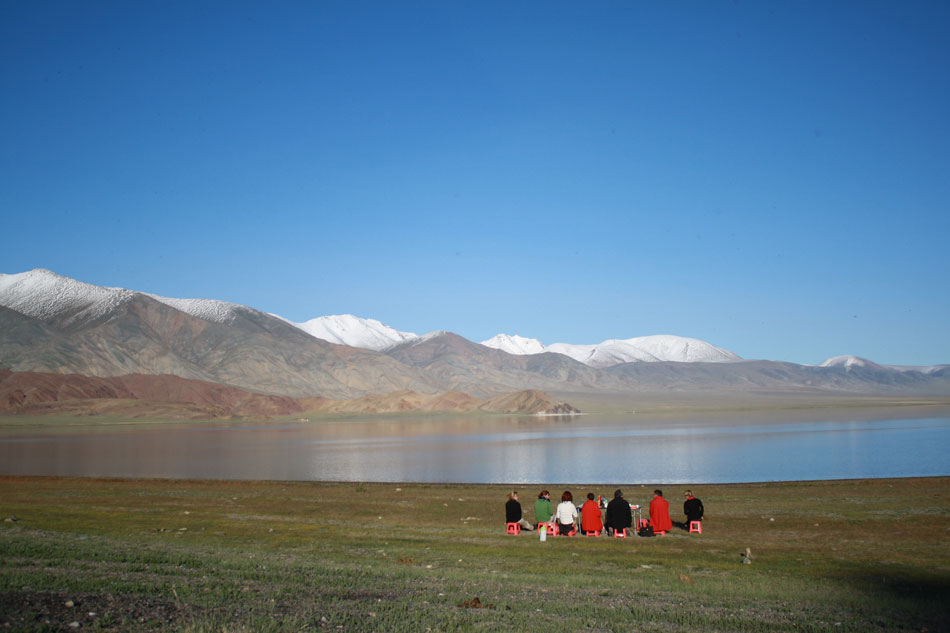
Tolbo Nuur (Frog Lake) is about 50km south of Olgii, on the main road between Olgii and Khovd city, so it’s an easy day trip or stopover. The saltwater lake is high (2080m), expansive and eerie, but a bit disappointing because the shoreline is treeless. There are a few gers around the lake, and the water is clean enough for swimming if you don’t mind icy temperatures. If you want to see, and camp at, some better lakes, keep traveling on to Uvs aimag.