Ergeliin Zoo.
The rocks of Ergeliin Zoo Natural Reserve are World famous for its paleontological remains of Dinosaurs of the Mesozoic Era. The Natural Reserve was declared in 1996 and covers 60,900Ha of land 30km northwest of the centre of Khatanbulag sum. The northern slope is sheer. Giant dinosaurs lived here in the Mesozoic Era and new finds of ancient animals are frequently recorded.
Spring of Kalzan Mountain.
Spring of Kalzan Mountain is located on the western slope of the Mountain and is composed of alluvial deposits. The composition of the spring water includes carbonic gas and radioactivity, and it has a sour taste!
Tsonjiin Chuluu.
Tsonjiin Stone has basalt formations with an amazingly regular hexagonal columnar structure resembling 6 sided symmetrical crystals
The man stone of Ar Ulaan.
It is like a sitting man holding a cup in his right hand while his left hand is placed on his knee. The 13-15th century head of the man stone is breaking away and his face has been weathered, it is located in Ar Ulaan, southwest of Ikhkhet sum. Size of the man stone is 133:41:130 cm.
Noyon Khutagt Danzanravjaa (1803-56), a well-known Mongolian writer, composer, painter and medic, was born about 100km south-west of Sainshand. The museum has a collection of gifts presented to Danzanravjaa by Chinese and Tibetan leaders, costumes used in his plays, Buddhist statues presented to him by the 10th Dalai Lama, and some of his paintings. He was also very interested in traditional medicine, so the museum has a collection of herbs. Look out for the jar in front of his statue, which contains the Danzanravjaa’s bones; the poet’s mummified body was burned along with his monastery in the 1930s.
The Monastery Khamariin Hiid.
Khamar Monastery was established in the 1820’s by the famous 19th century Mongolian educator and literary figure Danzanravjaa. The Monastery was an important centre of the Buddhist “red sect” and seat of the Gobiin Dogshin Noyon Khutagt (“Terrible Noble Saint of the Gobi”). An outspoken critic of the society in which he lived, Danzanravjaa fought against the rigid class and gender distinctions of his day. He devoted great efforts to the cause of public education, which he promoted at Khamar Monastery through the establishment of an inclusive public school, theatre, museum and library.
Noyon Uul.
Noyon Uul is an extinct volcano of the Gobi Altai mountain range. Its elevation is 2403m. There is a famous cliff, which has a smooth external appearance, shining like a mirror from a distance, and thus was called mirror rock. Sliding processes during episodes of folding movement formed the cliff.
Khongoryn Els
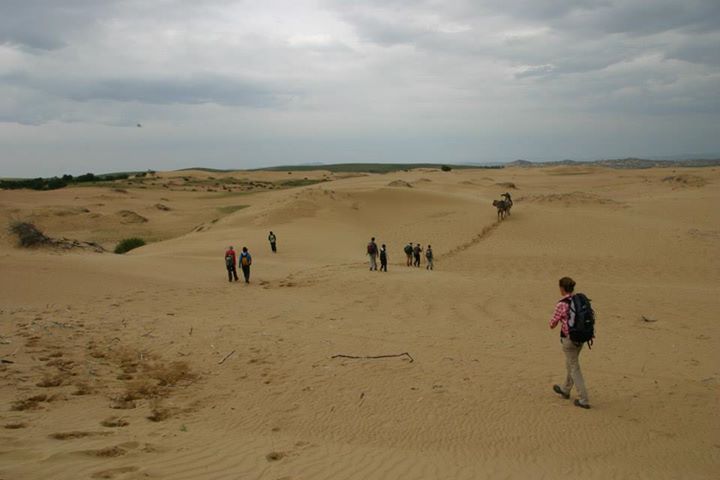
(Khongor sand dunes). An area named Khongor Els has an extraordinary length of 180km and 15-20km wide lies on the northern part of the mountains Sevree and Zuulun. Mountain Sevrei lies to the south of the dunes and the Khongoriin Gol (River) runs along the northern edges enabling lush green grass to grow, contrasting beautifully with the yellows of the dunes.
Gobi Gurvansaikhan
The mountain range of Gobi Gurvansaikhan is a National Park, enjoying State protection. The National Park covers an area 4,100km² and has enjoyed State protection since 1994.
The mountain range is composed of schist and sedimentary rocks of Paleozoic age and consists of three spurs: Baruun, Dund and Zuun Saikhan and extends for over 100 km. The highest peak is Zuun Saikhan Uul which reaches 2800m. The park also contains numerous types and species of fauna, including Argali sheep and ibex.
Yolyn am.
Yolyn am is the narrow canyon of a river which flows through Mountain Zuun saikhan (2815m), 62km northwest of Dalanzadgad town. The gorge has sheer rock walls with a height of about 200m in the central part. At its narrowest only two people can pass at a time. It has been protected since 1965.
Galbiin Gobi.
Galbiin Gobi is located on the territory of Khanbogd sum. In its northern part one can see the ruin of the tree monasteries built in the 17th century in which Noyon Khutagt danzan Ravjaa put on his plays. The ruins of the monasteries have enjoyed state protected area since 1998.
Hermen Tsav.
Hermen Tsav is a canyon with a beautiful oasis, 6 km wide and 15 km in length, located at a distance of 400 km from Dalanzadgad city. The canyon is 30m deep with natural formations of cliffs, and looks like the remains of ancient cities and temples or of icebergs drifting on the ocean, even like huge dinosaurs, turtles and crocodiles. Scientists have defined it as an inland sea bed from some 200 million years ago. Hermen Tsav is known not only by its beauty of natural formation but also by its trove of dinosaur fossils.
BaynZag.
Bayan Zag is located near the centre of Bulgan sum, and archaeological finds of the Palaeolithic Era where found here. Bayan zag is internationally famous for dinosaur remains including; complete dinosaur skeletons, eggs and hatchlings, from the Cretaceous period. Dinosaurs discovered here include Protoceratops, Oviraptor and heavy armoured Pinacosaurus. Dinosaur eggs with a diameter of 10-15cm have been found here, in Mongolia for the first time in the world.
Zulganai.
Is an oasis that is located 40km from the north of Khermentsav. The Zulganai river takes its source from the west mountain of Altan and flows to the west for 20km and then dissappears into the sand. The Zulganai River has a beautiful dense forest with cane and willow. The cane grows to about 3m high.
Otson Maanit.
The mountain Otson Maanit is 54km south east of Khanbogd sum on the way to Bayan Ovoo sum where the remains of ancient dwellings have been found. There is a cave of Gurvan zeerd over 60 meters in Khanbogd sum.
Serven Mountain (Teerem Tolgoi).
Teerem Tolgoi is south east from the Khuts mountain, on the east side of Serven mountain. Here are the remains of an ancient palace. You can see 14 square shaped red granite (90X90cm) foundation blocks, placed about 80m apart.
Valley of Gurvan Tes.
This wide and long valley supports groves of Saxual and sand, lying between the Mountain Noyon uul and Sevree uul. Pools are present with large deposits of salt. To the west is Khermen tsav which is covered with saxaul bushes.
Small Gobi A strictly Protected Area.
The strictly protected area is located in the south east
of Omnogobi aimag and straddles the boundary of Omnogobi and Dornogobi aimags. Small Gobi; a strictly protected area covers an area 18,391 km² and it was established national park in 1995. It has since been re-designated as a Strictly Protected Area. The protected area includes sand dunes, saxaul forest and it is rich in rare animals.